


Page 11 - Quick Ship Europe
P. 11
Everything else you should know


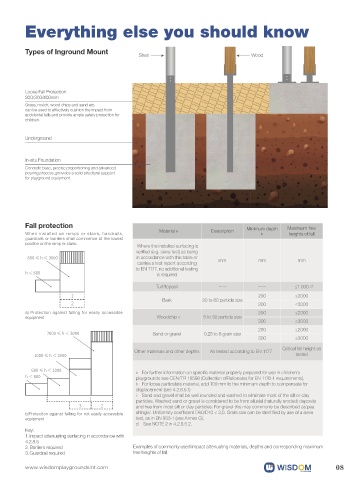
          Types of Inground Mount
                                                Steel                                 Wood


          Loose Fall Protection
          200/300/400mm
          Grass, mulch, wood chips and sand etc.
          can be used to effectively cushion the impact from
          accidental falls and provide ample safety protection for
          children.

          Underground


          In-situ Foundation
          Concrete base, precise proportioning and advanced
          pouring process, provides a solid structural support
          for playground equipment.


          Fall protection                                                                         Maximum free
                                                       Material a       Description  Minimum depth
          When installed on ramps  or stairs, handrails,                                 b        heights of fall
          guardrails or barriers shall commence at the lowest
          position on the ramp or stairs.
                                                Where the installed surfacing is
                                               verified (e.g. sieve test) as being
          600 ≤ h < 3000                       in accordance with this table or   mm    mm           mm
                                               carries a test report according
                                               to EN 1177, no additional testing
          h < 600                                     is required

                                                      Turf/topsoil         ——           ——          ≤1 000 d
                         1                                                              200          ≤2000
                         2                              Bark         20 to 80 particle size  300     ≤3000
          a) Protection against falling for easily accessible                           200          ≤2000
          equipment                                   Woodchip c      5 to 30 particle size
                                                                                        300          ≤3000
                                                                                        200          ≤2000
                 2000 ≤ h < 3000                     Sand or gravel   0,25 to 8 grain size
                                                                                        300          ≤3000
                                                                                                Critical fall height as
                                              Other materials and other depths  As tested according to EN 1177
             1000 ≤ h < 2000                                                                         tested
            600 ≤ h < 1000                     a    For further information on specific material properly prepared for use in children's
          h < 600                              playgrounds see CEN/TR 16598 (Collection ofRationales for EN 1176-1 requirements).
                                               b    For loose particulate material, add 100 mm to the minimum depth to compensate for
                                               displacement (see 4.2.8.5.1)
                                               c    Sand and gravel shall be well rounded and washed to eliminate most of the silt or clay
                               1               particles, Washed sand or gravel is considered to be from alluvial (naturally eroded) deposits
                            3      2           and free from most silt or clay particles. For gravel this may commonly be described as'pea
          b)Protection against falling for not easily accessible   shingle'. Uniformity coefficient D60/D10 < 3,0. Grain size can be identified by use of a sieve
          equipment                            test, as in EN 933-1 (see Annex G).
                                               d    See NOTE 2 in 4.2.8.5.2.
          Key:
          1. Impact attenuating surfacing in accordance with
          4.2.8.5
          2. Barriers required                Examples of commonly used impact attenuating materials, depths and corresponding maximum
          3. Guardrail required               free heights of fall.

          www.wisdomplaygroundsint.com                                                                            08

